China sends astronaut on year-long space mission as it eyes 2030 moon landing
China sends astronaut on year-long space mission as it eyes 2030 moon landing <br>
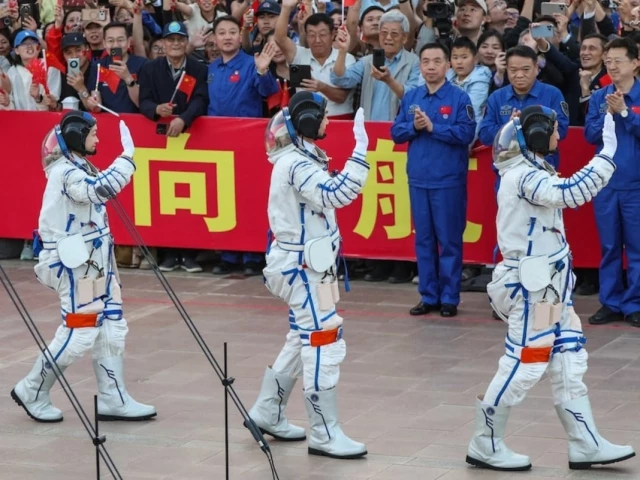
China sent three astronauts to its space station on Sunday, one of whom will stay for a year, a record length for the country, enabling the study of long-duration human physiology in space as Beijing works towards its ambition of a crewed moon ‌landing by 2030.
The Shenzhou-23 vessel launched at 11:08pm (1508 GMT) using the Long March-2F Y23 carrier rocket from Jiuquan Satellite Launch Centre in northwest China, with three Chinese astronauts on board.
Payload specialist Li Jiaying, a former Hong Kong police inspector, is the first astronaut from the city to take part in a Chinese space mission. The other crew members are Commander Zhu Yangzhu and Pilot Zhang Yuanzhi, both from the People's Liberation Army's astronaut division.
China, US set sights on Moon
One of the three is to stay on the Tiangong space station for a year, one of the longest space missions ever, but short of the 14-1/2-month record set by a Russian cosmonaut in 1995. That astronaut will be decided later, depending on the progress of the mission, the China Manned Space Agency said on Saturday.
🚀[Breaking] China launched the Shenzhou XXIII crewed spacecraft on Sunday, sending three astronauts toward the @CNSpaceStation.
👨‍🚀👨‍🚀👩‍🚀The spacecraft blasted into the night sky aboard a Long March 2F rocket from the Jiuquan Satellite Launch Center at 11:08 pm Beijing Time.… pic.twitter.com/B9ZQ5dBeqB
— Chinese Space Station (@CNSpaceStation) May 24, 2026
China has sent astronauts to its space station almost a dozen times, but this launch comes amid an accelerating race to the moon with the US, which has warned about what it alleges are Beijing's plans to colonise and mine lunar territory and resources.
Beijing has strongly rejected these claims.
NASA is seeking to achieve a crewed moon landing in 2028, two years ahead of China. The US aims to establish a long-term lunar presence as a stepping stone to eventual human exploration of Mars.
Read More: Pak astronauts undergoing training in China
In April, four NASA astronauts made a historic trip around the moon as part of the Artemis II mission, flying farther from Earth than anyone before in the world's first crewed lunar mission in half a century.
On Friday, Elon Musk's SpaceX made a largely successful, uncrewed test flight of its next-generation Starship rocket, which is designed to enable more frequent Starlink satellite launches and to send future NASA missions to the moon.
China, with less than four years until its 2030 deadline, faces a tall order of developing entirely new hardware and software specific to its lunar mission, ‌proving it is mission-ready. That will ensure its astronauts, used to the relative safety of Tiangong in low-Earth orbit, can safely make the riskier transition to the moon's surface.
A Long March 2F rocket carrying the Shenzhou-23 spacecraft with astronauts Zhu Yangzhu, Zhang Zhiyuan, and Lai Ka-ying, who is the first astronaut from Hong Kong, before it blasts off to China's Tiangong space station from the launchpad at the Jiuquan Satellite Launch Centre, near Jiuquan, Gansu province, China, May 24, 2026. REUTERS
China's Shenzhou missions have been sending trios of astronauts to the station for six-month stays since 2021. The Chinese space agency is training two Pakistani astronauts, one of whom could join an expected mission to Tiangong this year on a short-duration basis.
Goal of permanent lunar base by 2035
The previous mission, Shenzhou-22, was launched ahead of schedule in November to return three Chinese astronauts to Earth after their Shenzhou-20 vessel was damaged by space debris in orbit.
China has only sent robots to the moon, but its successive Shenzhou missions highlight the country's rapidly improving space capabilities. In June 2024, China became the first country to recover lunar samples from the moon's far side, using robots.
A successful crewed landing before 2030 would boost China's plans to establish a permanent base on the moon by 2035 with Russia.
The Chinese lunar programme's chief scientist, Wu Weiren, has said Beijing's public timeline is intentionally conservative.
Over the past year, Beijing has been carrying out safety tests of hardware developed for the 2030 mission, including heavy-lift Long March-10 rockets, the Mengzhou spacecraft and the Lanyue lunar lander.
The Shenzhou-23 flight will execute the first autonomous rapid rendezvous and docking procedure with the core module of Tiangong in preparation for the 2030 mission, which hinges on an automated lunar-orbit rendezvous between the Mengzhou capsule and the Lanyue lander.
Scientists will also study the physiological effects of radiation exposure, bone density loss and psychological stress in space for the extended duration of the Shenzhou-23 mission.
Beijing is conducting the world's first human "artificial embryo" experiment in space, having sent samples of human stem cells to the Shenzhou-22 crew on the Tiangong this month, state media reported. The experiment is intended to study the long-term residence, survival and reproduction of human beings in space.
<br> <img src="https://tribune.com.pk/story/2609859/china-sends-astronaut-on-year-long-space-mission-as-it-eyes-2030-moon-landing" alt=" China sends astronaut on year-long space mission as it eyes 2030 moon landing" width="100%">


Comments
Post a Comment