From science fair to strategic showcase: a decade of China’s robot games
From science fair to strategic showcase: a decade of China’s robot games <br>
It’s been called the Robot Olympics. But unlike the human Olympics, Team China is collecting almost all the medals.
Over the past decade, robotic competitions in China have provided a window into the advances of a now-surging sector – and the importance of its success as a strategic industry singled out by President Xi Jinping.
Once a curiosity organized by academic teams and hobbyists, China’s robot games have become a national showcase celebrated by state ‌media — and, increasingly, a proving ground for commercial products from companies looking to show real-world applications beyond the spectacle.
The five-day World Humanoid Robot Games – the latest and biggest incarnation of the competition – began on Saturday in Beijing.
Here’s a timeline of how the competitions, and the underlying technology, have developed:
1999 - 2014: Robotics as college sport
Robotics competitions in China started as lower-budget affairs backed by an industry association and the local government of Fujian. The competitors were mostly college teams. The vibe was more science project than showcase for the high-flying companies that emerged later.
In one showcase event, small, wheeled robots played a competitive version of soccer with a limited range of pre-programmed automation to avoid collisions and find the ball.
2015: Robotics as the “crown jewel”
In 2015, Beijing hosted the first World Robot Conference, marking the industry’s emergence as a national priority. A year earlier, Xi had declared robotics was the “crown jewel” of advanced manufacturing, according to state media.
At the 2015 exhibition, mobile robots faced off in badminton demonstrations, tracking shuttlecocks and returning volleys. It was a crowd-pleasing showcase — but hardly a breakthrough.
Robots like this relied on distance-image sensors developed in the 2010s and an even-older technology for estimating the track of an object pioneered by British defence researchers in the 1990s.
2023: From the lab to the living room
By 2023, the World Robot Conference had become a high-profile venue for established companies to showcase innovation and build buzz.
Along the way attention began to shift to China's competitive advantage on pricing.
Xiaomi's robot dog "Cyberdog" drew a ring of onlookers filming on smartphones.
The Cyberdog, first released as a hobbyist platform, cost about $1,500 on release. By comparison, Boston Dynamics’ quadruped Spot was selling for over $75,000.
2025-2026: From ‌stumbling start to great leap
In April 2025, humanoid robots lined up alongside human runners for the world's first robot half-marathon in Beijing.
Engineers jogged alongside their machines, ready to intervene. Only a fraction of the robots that started the course finished. Some collapsed on the starting line. Others crashed into the railing just a few metres in.
A year later, the robots were ready. A Unitree H1 robot sprinted unaccompanied down the finishing straight of the second Beijing half-marathon — no chaperone in sight.
Of the more than 100 robot teams that entered the competition in 2026, 47 finished, state media reported.
Most striking: a humanoid robot by Chinese smartphone maker Honor named “Flash” ran the half marathon autonomously in 50 minutes and 26 seconds. That was faster than the human world record set just a month earlier by almost 7 minutes.
Analysts and executives attributed the sharp and widespread improvements to the competitiveness of a growing supply chain bolstered by subsidies and the falling cost of components.
Read More: China readies robotic lunar mission in search for water ice
The visible hand of the state drove some of those gains.
Beijing's 2021 five-year blueprint for the robotics sector had promised subsidies, research tax breaks and financing, setting a goal for China to become “a global wellspring of robotics technology innovation.”
2026 and onward: It’s all in the hands
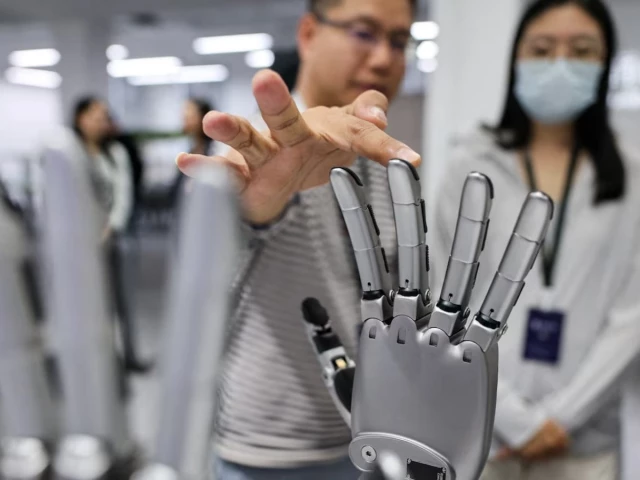
In 2026, the World Humanoid Robot Games add a challenge for robotic hands.
Robots will be judged on their speed and accuracy in precision tasks: tightening screws, opening bottles and picking up beads with tweezers.
Analysts say engineering a hand is the most complex challenge for building a humanoid that can work with the precision and touch of a human.
The shift to work tasks in the games also reflects the increasingly crowded industry’s biggest problem: showing prototypes can work in the real world.
<br> <img src="https://tribune.com.pk/story/2625268/from-science-fair-to-strategic-showcase-a-decade-of-chinas-robot-games" alt=" From science fair to strategic showcase: a decade of China’s robot games" width="100%">


Comments
Post a Comment